Speak with support, then more independently
Inglés · Unidad 4: Communicate in short texts
Qué aprenderás
- Comprender guided oral production desde la idea básica.
- Seguir un ejemplo explicado antes de practicar guided oral production.
- Reconocer el error “Memorizing sounds without knowing what the sentence means.” y saber cómo corregirlo.
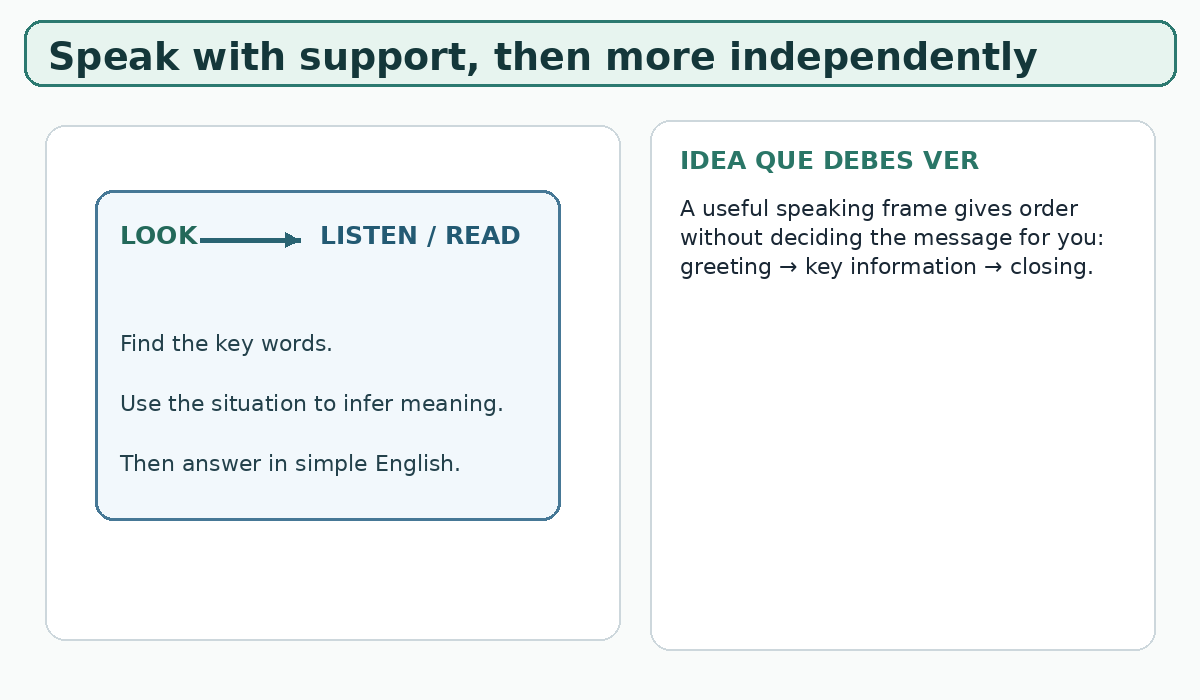
Listen and repeat slowly. Speak with support, then more independently
En televisores, la síntesis de voz depende del navegador. No se fuerza una voz inglesa sobre explicaciones en español.1. Qué aprenderás
Esta clase parte desde cero con guided oral production. Primero la app explica la idea, luego muestra cómo se usa y recién después te pide practicar. Idea central: A useful speaking frame gives order without deciding the message for you: greeting → key information → closing.
- No necesitas saber guided oral production de memoria antes de empezar.
- Al terminar deberías poder explicar guided oral production con tus palabras y reconocer cuándo usar esta idea.
2. Base necesaria
Para empezar no necesitas traducir todo. La clase primero aclara el significado de guided oral production con contexto y un modelo breve; después usa el inglés.
- En “Speak with support, then more independently”, todavía no tienes que resolver nada: esta parte sólo recupera la base necesaria para guided oral production.
- Si la base de guided oral production no está clara, vuelve al apoyo visual o al ejemplo de esta lección antes de avanzar.
3. Explicación: entiende la idea
A useful speaking frame gives order without deciding the message for you: greeting → key information → closing. En Inglés el orden es significado → modelo → uso. Primero comprendes el mensaje; luego reconoces palabras o estructura; recién después produces una respuesta.
- Qué significa aquí: guided oral production.
- Qué debes evitar confundir con la idea: Memorizing sounds without knowing what the sentence means.
4. Ejemplo explicado paso a paso
Observa el modelo antes de intentar hacerlo solo. La idea que usaremos es: A useful speaking frame gives order without deciding the message for you: greeting → key information → closing. El procedimiento del ejemplo es: Listen to a model, identify its parts, rehearse with a word bank, then change the details.
- Paso 1: Escucha o lee el modelo completo antes de traducir palabra por palabra.
- Paso 2: Listen to a model, identify its parts, rehearse with a word bank, then change the details.
- Paso 3: Comprueba el significado con el contexto y repite o produce una frase breve sólo después de entenderla.
5. Error frecuente y cómo corregirlo
Error frecuente: Memorizing sounds without knowing what the sentence means. El error “Memorizing sounds without knowing what the sentence means.” dificulta comprender o comunicar el significado que muestra el modelo. La corrección no consiste en cambiar sólo la respuesta final: hay que volver a la idea y al paso donde comenzó la confusión.
- Idea con la que se corrige: A useful speaking frame gives order without deciding the message for you: greeting → key information → closing.
- Criterio para volver a intentarlo: Listen to a model, identify its parts, rehearse with a word bank, then change the details.
6. Ahora practica con ayuda
Ahora sí puedes usar lo que acabas de ver. Caso guiado: Give a 20-second fictional introduction using a model and visual prompts.
- Busca primero la palabra o pista que cambia el significado; luego usa el modelo.
- Si te bloqueas, vuelve al ejemplo y usa este criterio: Listen to a model, identify its parts, rehearse with a word bank, then change the details.
- Antes de seguir en “Speak with support, then more independently”, explica por qué tu respuesta coincide con la idea central de guided oral production.
7. Prueba en una situación nueva
En otro mensaje sobre guided oral production, cambia la información pero conserva el patrón que ya comprendiste.
- La idea que debe mantenerse es: A useful speaking frame gives order without deciding the message for you: greeting → key information → closing.
- En la transferencia de “Speak with support, then more independently”, cambia el caso o los datos sin copiar la respuesta del ejemplo.
- Si el caso nuevo de guided oral production exige otra decisión, explica qué cambió y por qué.
8. Cierre: qué debes recordar
Qué debes llevarte de “Speak with support, then more independently”: A useful speaking frame gives order without deciding the message for you: greeting → key information → closing. El procedimiento útil es: Listen to a model, identify its parts, rehearse with a word bank, then change the details. El error que conviene reconocer y corregir es: Memorizing sounds without knowing what the sentence means.
- Primero entiende guided oral production; después usa el procedimiento; al final comprueba.
- Si en “Speak with support, then more independently” todavía necesitas mirar el ejemplo, vuelve a él: la meta es comprender guided oral production, no avanzar por velocidad.
Práctica
- Memorizing sounds without knowing what the sentence means.
- A useful speaking frame gives order without deciding the message for you: greeting → key information → closing.
- A short text should first communicate the intended meaning; then check capital letters, word order, familiar spelling and punctuation.
- Model: “My favourite place is the park because I play there.” A model shows structure; your words provide the new meaning.
- Read the text aloud slowly, compare with the model and correct one type of issue at a time.
- Listen to a model, identify its parts, rehearse with a word bank, then change the details.
- Memorizing sounds without knowing what the sentence means.
- Plan the message in Spanish or with pictures if needed, choose known vocabulary, then build one sentence at a time.
- Focusing on one misspelled word while leaving a sentence whose word order changes the meaning.
- Idea: A useful speaking frame gives order without deciding the message for you: greeting → key information → closing.
- Copying a model exactly so the final text no longer communicates your own intended information.
- Give a 20-second fictional introduction using a model and visual prompts.
- Give a 20-second fictional introduction using a model and visual prompts.
- Write three connected sentences about a fictional place.
- Improve a short message using a simple four-point checklist.
- Memorizing sounds without knowing what the sentence means.