Give simple directions
Inglés · Unidad 3: Places, routines and directions
Qué aprenderás
- Comprender directions desde la idea básica.
- Seguir un ejemplo explicado antes de practicar directions.
- Reconocer el error “Trying to follow all directions at once without tracking the route.” y saber cómo corregirlo.
Listen and repeat slowly. Give simple directions
En televisores, la síntesis de voz depende del navegador. No se fuerza una voz inglesa sobre explicaciones en español.1. Qué aprenderás
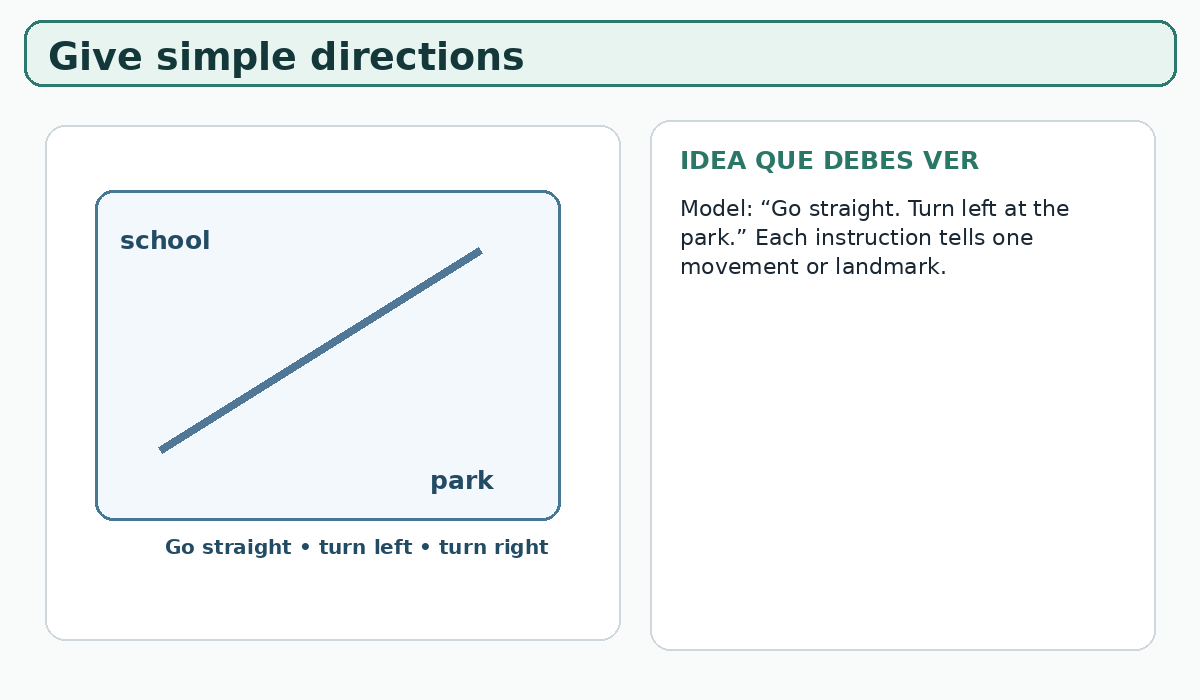
Esta clase parte desde cero con directions. Primero la app explica la idea, luego muestra cómo se usa y recién después te pide practicar. Idea central: Model: “Go straight. Turn left at the park.” Each instruction tells one movement or landmark.
- No necesitas saber directions de memoria antes de empezar.
- Al terminar deberías poder explicar directions con tus palabras y reconocer cuándo usar esta idea.
2. Base necesaria
Para empezar no necesitas traducir todo. La clase primero aclara el significado de directions con contexto y un modelo breve; después usa el inglés.
- En “Give simple directions”, todavía no tienes que resolver nada: esta parte sólo recupera la base necesaria para directions.
- Si la base de directions no está clara, vuelve al apoyo visual o al ejemplo de esta lección antes de avanzar.
3. Explicación: entiende la idea
Model: “Go straight. Turn left at the park.” Each instruction tells one movement or landmark. En Inglés el orden es significado → modelo → uso. Primero comprendes el mensaje; luego reconoces palabras o estructura; recién después produces una respuesta.
- Qué significa aquí: directions.
- Qué debes evitar confundir con la idea: Trying to follow all directions at once without tracking the route.
4. Ejemplo explicado paso a paso
Observa el modelo antes de intentar hacerlo solo. La idea que usaremos es: Model: “Go straight. Turn left at the park.” Each instruction tells one movement or landmark. El procedimiento del ejemplo es: Follow one instruction at a time on a map and check your position before the next step.
- Paso 1: Escucha o lee el modelo completo antes de traducir palabra por palabra.
- Paso 2: Follow one instruction at a time on a map and check your position before the next step.
- Paso 3: Comprueba el significado con el contexto y repite o produce una frase breve sólo después de entenderla.
5. Error frecuente y cómo corregirlo
Error frecuente: Trying to follow all directions at once without tracking the route. El error “Trying to follow all directions at once without tracking the route.” dificulta comprender o comunicar el significado que muestra el modelo. La corrección no consiste en cambiar sólo la respuesta final: hay que volver a la idea y al paso donde comenzó la confusión.
- Idea con la que se corrige: Model: “Go straight. Turn left at the park.” Each instruction tells one movement or landmark.
- Criterio para volver a intentarlo: Follow one instruction at a time on a map and check your position before the next step.
6. Ahora practica con ayuda
Ahora sí puedes usar lo que acabas de ver. Caso guiado: Guide a character from school to a library on a simple map.
- Busca primero la palabra o pista que cambia el significado; luego usa el modelo.
- Si te bloqueas, vuelve al ejemplo y usa este criterio: Follow one instruction at a time on a map and check your position before the next step.
- Antes de seguir en “Give simple directions”, explica por qué tu respuesta coincide con la idea central de directions.
7. Prueba en una situación nueva
En otro mensaje sobre directions, cambia la información pero conserva el patrón que ya comprendiste.
- La idea que debe mantenerse es: Model: “Go straight. Turn left at the park.” Each instruction tells one movement or landmark.
- En la transferencia de “Give simple directions”, cambia el caso o los datos sin copiar la respuesta del ejemplo.
- Si el caso nuevo de directions exige otra decisión, explica qué cambió y por qué.
8. Cierre: qué debes recordar
Qué debes llevarte de “Give simple directions”: Model: “Go straight. Turn left at the park.” Each instruction tells one movement or landmark. El procedimiento útil es: Follow one instruction at a time on a map and check your position before the next step. El error que conviene reconocer y corregir es: Trying to follow all directions at once without tracking the route.
- Primero entiende directions; después usa el procedimiento; al final comprueba.
- Si en “Give simple directions” todavía necesitas mirar el ejemplo, vuelve a él: la meta es comprender directions, no avanzar por velocidad.
Actividad de desarrollo
Explica con tus palabras cómo usarías directions en una situación nueva relacionada con “Give simple directions”. Puedes usar un caso ficticio.
Práctica
- Trying to follow all directions at once without tracking the route.
- Model: “Go straight. Turn left at the park.” Each instruction tells one movement or landmark.
- “There is a park” describes one place or thing. “There are two shops” describes more than one.
- “I get up at seven.” links an action with a time. Context and clock images help before any translation.
- Look at quantity first, choose is or are, and then say what is in the place.
- Identify the action, then the time expression, then check whether the sentence matches the picture.
- Follow one instruction at a time on a map and check your position before the next step.
- Trying to follow all directions at once without tracking the route.
- Guide a character from school to a library on a simple map.
- Using “there is” with every plural noun.
- Idea: Model: “Go straight. Turn left at the park.” Each instruction tells one movement or landmark.
- Confusing the time with the order of all daily activities.
- Guide a character from school to a library on a simple map.
- Trying to follow all directions at once without tracking the route.
- Describe a simple town map with three modelled sentences.
- Match routine sentences to clocks and put a fictional day in sequence.