Speak: greetings and introductions
Inglés · Feelings and opinions
Qué aprenderás
- Usar estrategias antes, durante y después de hablar para expresarse con mayor claridad y fluidez.
participate in short conversations and interactions
En televisores, la síntesis de voz depende del navegador. No se fuerza una voz inglesa sobre explicaciones en español.Qué aprenderás
Usar estrategias antes, durante y después de hablar para expresarse con mayor claridad y fluidez. En esta lección lo harás con «Speak: greetings and introductions». No necesitas saberlo de antemano: primero verás un modelo y luego practicarás.
- Identifica el propósito de la actividad
- Aprende una forma o estrategia concreta
- Practica con apoyo antes de responder solo
Explicación paso a paso
No se supone que ya domines este contenido. Base necesaria: no tienes que adivinar ni traducir todo. Primero reconoce la situación y el significado de dos o tres expresiones clave; luego vuelve a la frase completa para reconstruir el mensaje. Primero comprende esta base y después sigue la explicación de la lección. Primero comprende el mensaje; después observa la forma del inglés. Hi/Hello = hola; I’m… = soy…; Nice to meet you = gusto en conocerte. Responde y luego devuelve una pregunta breve. Si aparece una palabra desconocida, no te detengas de inmediato: usa la situación, las palabras conocidas y la estructura para inferir el sentido. Sólo después confirma el significado si todavía lo necesitas.
- Use the visual prompt for “Personal information and communication — lesson 3” to predict vocabulary and meaning before listening, reading, speaking or writing.
Ejemplo resuelto
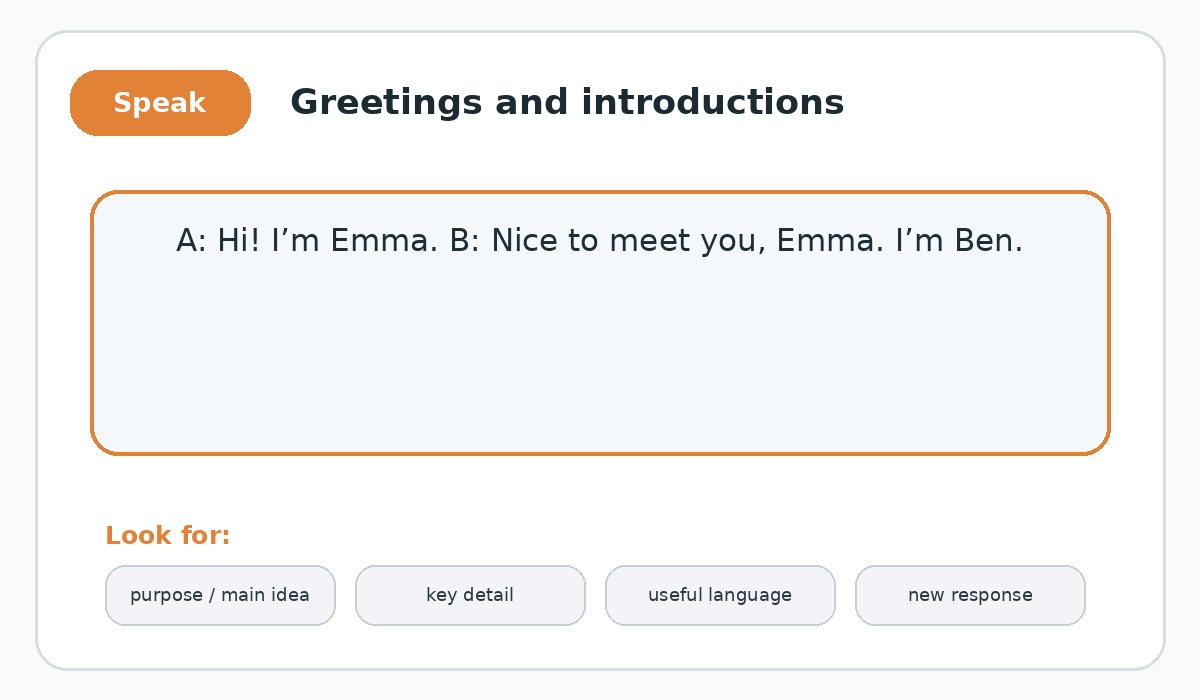
Modelo antes de practicar: «A: Hi! I’m Emma. B: Nice to meet you, Emma. I’m Ben.». Paso 1: identifica la situación y la idea general. Paso 2: busca las palabras exactas que aportan el dato pedido. En este modelo, la respuesta clave es «Introducing himself». Forma o estrategia que debes aprender: Hi/Hello = hola; I’m… = soy…; Nice to meet you = gusto en conocerte. Responde y luego devuelve una pregunta breve. Paso 3: cambia un dato y produce una frase nueva para comprobar que entendiste, en vez de memorizar el ejemplo.
Notice the language
Evita traducir palabra por palabra, responder por una palabra aislada o copiar el modelo sin adaptarlo. Si te equivocas, vuelve al modelo, identifica la pista exacta y prueba otra frase con información diferente. En «Speak: greetings and introductions», conecta este paso con una evidencia concreta: The key detail is: Introducing himself.
Use it in context
Ahora usa esta forma o estrategia con información nueva: Hi/Hello = hola; I’m… = soy…; Nice to meet you = gusto en conocerte. Responde y luego devuelve una pregunta breve. Cambia al menos un dato del modelo y explica qué parte del texto o de la frase te permitió responder.
- Use the language in a different context. Produce a short response that communicates a complete idea, not only isolated vocabulary.
Antes de practicar solo
Esta parte aparece solo después de la explicación y el ejemplo. Recuerda: Hi/Hello = hola; I’m… = soy…; Nice to meet you = gusto en conocerte. Responde y luego devuelve una pregunta breve. Si no lo recuerdas, vuelve al ejemplo resuelto. Después practica con un ítem distinto; no necesitas agotar todo el banco para completar la lección.
- Complete the tasks. Speaking and writing responses use guided review and do not receive automatic grades from keywords.
- Classify your error: meaning, vocabulary, grammar, pronunciation/listening, spelling or task instruction. Correct that specific point and try again.
Práctica
- Saying goodbye
- Introducing himself
- Ordering food
- Asking the time
- Translate every word first.
- I no understand nothing.
- Thanks! And what about you?
- Copy the same sentence without listening.
- Focus on one isolated word and ignore the situation.
- Memorize the whole text without understanding it.
- Choose an answer before reading or listening.
- Identify the purpose or main idea, then look for key details.
- Use the same useful language pattern with new personal information.
- Copy the model without changing anything.
- Translate the model word by word only.
- Remember the title but not use the language.