Read: sequence events in a short story
Inglés · Sports and free time activities
Qué aprenderás
- Comprender textos literarios simples identificando tema, personajes, acciones, ambiente, trama y vocabulario clave.
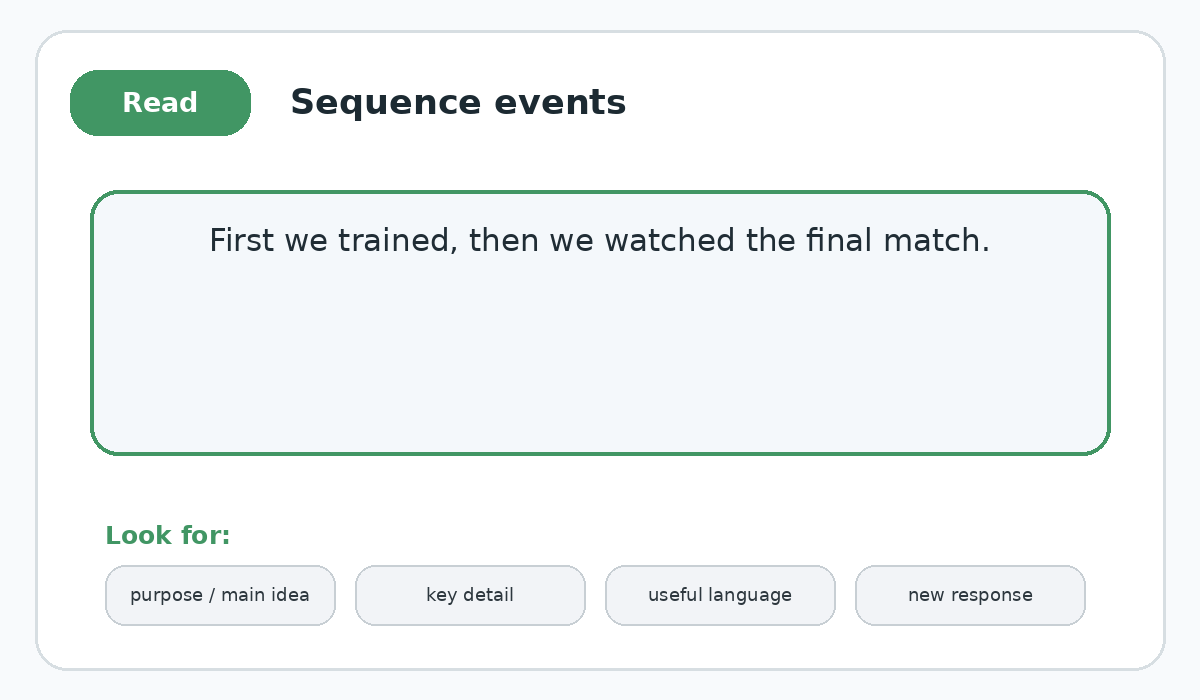
revise vocabulary, spelling and grammar in context
En televisores, la síntesis de voz depende del navegador. No se fuerza una voz inglesa sobre explicaciones en español.Qué aprenderás
Comprender textos literarios simples identificando tema, personajes, acciones, ambiente, trama y vocabulario clave. En esta lección lo harás con «Read: sequence events in a short story». No necesitas saberlo de antemano: primero verás un modelo y luego practicarás.
- Identifica el propósito de la actividad
- Aprende una forma o estrategia concreta
- Practica con apoyo antes de responder solo
Explicación paso a paso
No se supone que ya domines este contenido. Base necesaria: no tienes que adivinar ni traducir todo. Primero reconoce la situación y el significado de dos o tres expresiones clave; luego vuelve a la frase completa para reconstruir el mensaje. Primero comprende esta base y después sigue la explicación de la lección. Primero comprende el mensaje; después observa la forma del inglés. En una historia breve busca personaje, lugar y secuencia. first = primero; then = luego; finally = finalmente. Si aparece una palabra desconocida, no te detengas de inmediato: usa la situación, las palabras conocidas y la estructura para inferir el sentido. Sólo después confirma el significado si todavía lo necesitas.
- Use the visual prompt for “Sports, culture and free time — lesson 8” to predict vocabulary and meaning before listening, reading, speaking or writing.
Ejemplo resuelto
Modelo antes de practicar: «Leo arrived at the sports centre. First, he warmed up. Then he trained with his team. Finally, he watched the match.». Paso 1: identifica la situación y la idea general. Paso 2: busca las palabras exactas que aportan el dato pedido. En este modelo, la respuesta clave es «First, Leo warmed up. The words first, then and finally show the sequence of the short story». Forma o estrategia que debes aprender: En una historia breve busca personaje, lugar y secuencia. first = primero; then = luego; finally = finalmente. Paso 3: cambia un dato y produce una frase nueva para comprobar que entendiste, en vez de memorizar el ejemplo.
Notice the language
Evita traducir palabra por palabra, responder por una palabra aislada o copiar el modelo sin adaptarlo. Si te equivocas, vuelve al modelo, identifica la pista exacta y prueba otra frase con información diferente. En «Read: sequence events in a short story», conecta este paso con una evidencia concreta: First, Leo warmed up.
Use it in context
Ahora usa esta forma o estrategia con información nueva: En una historia breve busca personaje, lugar y secuencia. first = primero; then = luego; finally = finalmente. Cambia al menos un dato del modelo y explica qué parte del texto o de la frase te permitió responder.
- Use the language in a different context. Produce a short response that communicates a complete idea, not only isolated vocabulary.
Antes de practicar solo
Esta parte aparece solo después de la explicación y el ejemplo. Recuerda: En una historia breve busca personaje, lugar y secuencia. first = primero; then = luego; finally = finalmente. Si no lo recuerdas, vuelve al ejemplo resuelto. Después practica con un ítem distinto; no necesitas agotar todo el banco para completar la lección.
- Complete the tasks. Speaking and writing responses use guided review and do not receive automatic grades from keywords.
- Classify your error: meaning, vocabulary, grammar, pronunciation/listening, spelling or task instruction. Correct that specific point and try again.
- Revisión guiada: Explica o desarrolla una propuesta breve sobre «Sports, culture and free time — lesson 8».
Actividad de desarrollo
Explica o desarrolla una propuesta breve sobre «Sports, culture and free time — lesson 8».
Práctica
- He watched the match
- He warmed up
- He trained with his team
- He went home
- Stop reading immediately.
- Translate every word before finding the main idea.
- Use the situation, familiar words and sentence structure to infer meaning.
- Ignore the rest of the sentence.
- Focus on one isolated word and ignore the situation.
- Memorize the whole text without understanding it.
- Choose an answer before reading or listening.
- Identify the purpose or main idea, then look for key details.
- Use the same useful language pattern with new personal information.
- Copy the model without changing anything.
- Translate the model word by word only.
- Remember the title but not use the language.